
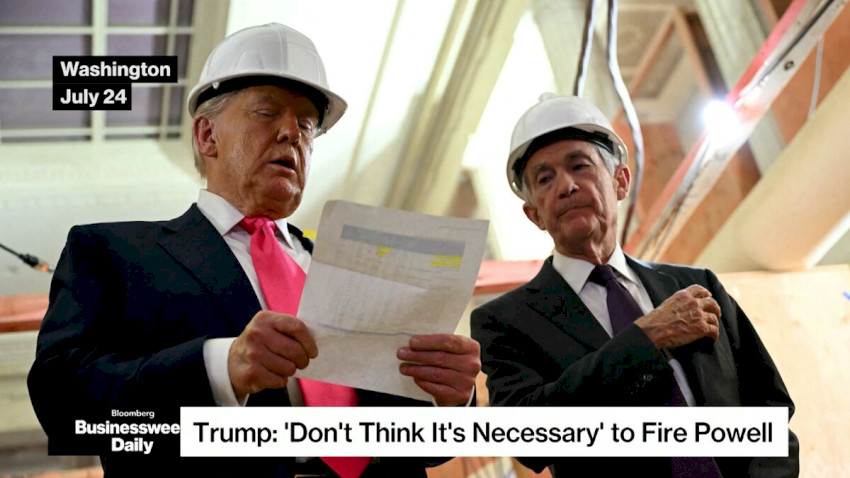
00:00So I’m going to talk to you about it as if I were in my former seat at the Fed. And and I would tell you I would be aware of it, but I would be striving to make sure it does not enter into my thinking at all. And I think for most of the folks at the Fed and around the FOMC table, they’re very focused, as I would be, on trying to make the right decision in July and then in September. And I would I would basically expect them to extend humanly possible screen out some of the activities going on externally. How do you do that? I mean, this is a psychological question as much as it is a question about data and the Fed’s dual mandate. But but how do you drown out the noise when it seems to be coming, at least in our world, almost 24 seven. So the way you drown out the noise, I would say, is the task of figuring out right now with some of these crosscurrents, we have the task of figuring out what’s the right way to administer monetary policy that’s consuming enough. And and I think there’s a real ethic and culture at the Fed and around the table to divorce your decisions from political pressure or political considerations. And that’s really firmly ingrained. And I think it’s also between colleagues. It’s self-reinforcing. You reinforce it with each other. I think the current situation, which I can get into, is complicated enough that would be consuming all of my attention, that I would be having my team very focused on how I how to weigh these tradeoffs. And the president continues to say, Rob, that, you know, venture Japan is going to do the right thing. You look at the economy, you do so for, you know, your team over at Goldman Sachs and some of the clients. How do you see the economy? What is the right thing in terms of monetary policy right now, in your view? So here’s what I’m seeing in the economy. And I spend bulk of my time with clients across our divisions globally. The US economy is is solid, but I would say growth is sluggish. And what do I mean by sluggish? We expect GDP growth this year is one in a fraction. Not a recession, but sluggish. The labor force is tight. But but the reason it’s so tight, it’s it’s that businesses are not hiring very aggressively, but they’re also not firing. And we’ve got a lack of immigration. We’ve got a real uncertainty with 10 million plus undocumented immigrants that are in the workforce. So the unemployment rate’s likely to see sticky. In addition, in the macro elements are such, you’ve got enormous global overcapacity in goods driven heavily by China, overcapacity. We’ve got an air artificial intelligence boom which should be disinflationary. And the counter to this is we’ve got this tariff situation going on, which still isn’t yet resolved. But I would say the following the range of outcomes for tariffs in April were very wide. They’ve now narrowed down. They may be as low as low to mid teens. They may be as high as high teens, the low twenties, that’ll that’s allowed businesses to get a pretty good grip on what their strategies will be, how much they want to take from suppliers in negotiations, how much has to come out of March and how much will go in price. And so the thing I’d be struggling with at the Fed is in this disinflationary context, how much will these tariffs lead to more persistent price pressures, or are they more likely to be a one time price issue, cost issue, which then over the horizon will get absorbed and we will return back to a more disinflationary environment, which I would argue is where we are predominantly globally outside the United States. And I’m not ready to conclude that it’s time to act in July, but I’d be getting my team ready to be prepared potentially to take action in the September meeting in the United States. Okay. Potentially take action in the September meeting. So it’s it’s a ways away, but not really a ways away. Just after Jackson Hole in August is right. So if we think about this from the perspective of the United States economy and what you said about immigration and the uncertainty around the 10 million plus undocumented workers are 8 million. However, whatever number we’re using to measure this difficult to measure workforce here in the U.S. is the net effect of President Trump’s immigration policy inflationary or disinflationary it. The net effect on the workforce as you much have, you have a very tight workforce. And this is why businesses are reluctant to fire. That means that wages and this, I think is a good thing are probably firmer. You do not have, though, on the fiscal side, some of these big government directed programs like the American Rescue Act, Inflation Reduction Act, Infrastructure and Chips Act. You know that that spigot of government directed spending has been stood down. It’s probably been replaced, though, by more stimulus, tax on overtimes, tax on tips, accelerated depreciation and others. And I think that the net of effect of what’s going on over the horizon, that may in fact, when we’re looking back a year from now, may say that the overall trend has been disinflationary. The tariffs have basically interrupted that. But only for a period of time. And we’re returning to a disinflationary. CHIEN But but I’m not sure yet. And that’s what I’d be trying to figure out. And I think that’s what the Fed participants are trying to figure out right now. What is the biggest risk to the U.S. economy right now? Is it the tariffs and the deals that are being worked out? I would say the following. We’re we’re going to we’re going to go into 2026 with some additional stimulus coming from the bill that was just passed. We’ve got a very tight labor force. I think a risk is most businesses I talked to are struggling to find workers, particularly in the service sector. I think there may have to be a look at increasing legal immigration and or clarifying the status of these millions of undocumented immigrants, because businesses are telling me they’re struggling to find workers. And then, yes, on the tariffs, if if we’re in the low to mid teens, I think the risk of being able to manage this is lower. I think if they’re mid to high teens or 20%, I think it will take longer. And I’m still overall optimistic about next year. The biggest concern I have for the U.S. economy is the deficit. We’re now net debt to GDP over 100%. We’re going to run this year as high as a 7% of GDP deficit, although we’ll have to see. And I still think our ability to sell long duration treasuries is still our biggest challenge. And that’s the biggest thing I’m concerned about. We are, of course, talking with Rob Kaplan, vice chairman over Goldman Sachs, former president and CEO of the Federal Reserve Bank of Dallas, joining us from the Bloomberg News bureau in Dallas. Hey, Rob, one thing I wanted to ask you, former Treasury and White House National Economic Council chief Larry Summers said on Bloomberg television’s Wall Street Week with David Westin that he backed Treasury Secretary Scott Benson’s questioning of the Fed’s Nonmonetary policy activities and saying that there were some areas that are distinct from the broader issue of central bank independence. I think it’s safe to say that even some that really fiercely defend Fed independence say it is a good idea to review. Do you think the Fed has overreached in some areas? I think there’s two or three areas that are healthy to look at. One, the Fed has very aggressively used its balance sheet, increased its balance sheet QE in the last number of years. I think there’s an argument and it’s worth a debate. Maybe the bar should be higher to roll out the balance sheet in the midst of a downturn. Emergency powers. Yes, maybe a higher bar for using that balance sheet because it has a distorting effect on the Treasury market and financial markets. I think I think some of the changes that are being made now to do a revamp of bank regulation I think are constructive. And I think those are good news. And then to to the points that have been made, I think it’s always a good idea to take a look at the Fed. How can we operate better? There’s 12 reserve banks. There’s a big board of governors. Are there operations that could be integrated? Could there be more efficiencies created to be to make it more economical? Sure. There are opportunities there. And I think that kind of review, though, is healthy and constructive and and I think should be expected. And I think it’s a positive thing for the Fed. Rob, forgive me for going back to kind of where we started. And I think about, man, I would be super rich and living probably on Anguilla if I had a book for every time I said we are living in unusual and at times, but watching yesterday, Tim has been doing this a long time. I’ve been doing this a long time to see a president with a Fed chair touring the Federal Reserve. I think it’s fair to say that was super unusual. That has happened in two decades. So tell me, someone who understands the Fed the importance of Fed independence. And it’s you know, your conversations are the things you were being asked around that and what you think is the productive takeaway from seeing that or were you as shocked as kind of we all were? Yeah, well, I thought I thought Jay Powell handled it very well. And I really think that as a leader of the Fed and I would guess what they’re saying inside the Fed, please screen this out. Let’s focus on the job at hand. We’ve got a big job to do. The job is not finished. Let’s make sure we’re focused on the July meeting. The September meeting. Our role in bank supervision and all the other community activities we do that is got to be the overwhelming focus to me watching the events of yesterday. It reminds me back to what I said earlier. We are much more highly leveraged than we were pre-COVID, whether we like it or not. Now it’s spurred economic growth in the last three or four years, but some of that was due to excess fiscal spending. I do think the big looming issue for the country and I’m optimistic generally we are going to have to find ways to moderate our debt growth to be aware of the fact we’re running a historically high deficit at a time of full employment. We tend to run big deficits. And when we have high unemployment, not low unemployment. So this sensitivity to the cost of everything, I think that part of it I think is a constructive development. And we’re going to have to do more to find ways to de-leverage and moderate our debt growth for the good of our kids and our grandkids and to have a healthier economy. Do you think Fed Chair Jay Powell concludes his term in May 2026 as chair of the Federal Reserve and then serves until January 2028 on the Board of Governors? I’ll leave it to Jay to talk about what he does after he’s done being Fed chair. I would I would guess I would. I believe strongly he will finish out his term as chair. It wouldn’t surprise me if he made the decision then to step down at that time. But he’ll he’ll make that decision. But I I’d be optimistic that he will finish out his term as chair. Do you think Wait, I got to just add, because Professor Judge asked this, you know, when the president might take any more steps to put more pressure on Fed Chair Jay Powell, do you think it’s just going to be the same drumbeat or do you think he could take it even further? So, listen, I will say this. The sequence of events over the last several months have meant that the next Fed chair will have a onus on him or her to demonstrate that they are divorced from politi cal pressure and political considerations, very critical to the leadership of the Fed, that they demonstrate that. And I think it’s critical to people in the economy and the financial markets, not just here but around the world, that that person demonstrate that. And I think this just increases the emphasis on their need to demonstrate that. And I’m hopeful they will.Stream Schedule:US BTV+
No schedule data available.
Source: OriginalArticle